Showing posts with label IB. Show all posts

Monday, 2 March 2020

Creating a classroom culture for learning: Breaking Bad Habits Part 2 - The power of pronouns


 YOU

You need to improve your…….

When will you learn that……

This is your fault. You did this………

Such statements appear regularly both in our personal and professional lives. Language which has been with us since our early childhood. Language which has become habitual and to some degree helps frame our perceptions of the world. But our language also communicates both intended and unintended messages to those around us. In particular the pronouns You or Your can potentially create a sense of segregation - an us and them mentality. We should not underestimate the power of a single word or phrase. As Ron Ritchhart states in Creating Cultures of Thinking:

“And that is the thing about language, it is at once ubiquitous, surrounding us constantly, yet we hardly take note of its subtleties and power. And due to its constant presence, it is shaping our behaviour, interactions, thinking, attention, and feelings in ways that we might not be consciously aware of." 

In any given classroom at any given time of the day how many times will the word you be spoken by a teacher? And what does this say about the relationship between the teacher and students?  Don’t get me wrong there are situations where perhaps the use of you and your are necessary, but there are many other times when we would be better served using inclusive pronouns: We and Our. Over time they will hopefully help create a climate of safety and trust between teacher and student. So in the spirit of creating a sense of community and togetherness in our classrooms below are some possible alternative statements:

We need to ensure that our classroom is left tidy after each lesson.
We have high expectations regarding our conduct. Can you remind us how we should enter the classroom?
Today we are reading the prologue to Romeo & Juliet. 
I know it is a struggle but using our collective minds I am confident we can do this.

Friday, 28 February 2020

Creating a classroom culture for learning: Breaking Bad Habits Part 1 - Wait Time


Sometimes the simplest educational strategies are the hardest to implement. The classic example - wait time. It’s not simply a case of knowing that as teachers we should allow wait time to occur; we know that thinking does not have to be fast and it is not a prerequisite for intelligence; we know that not all students have quick processing speeds and that allowing longer processing time is an inclusive strategy; we know that our students can be shrewd, and quickly realise they can avoid thinking if they don’t put up their hands immediately; and we know as teachers it is part of our role to deal with the uncomfortable pause and the inevitable slowing down of time - yet try as we might employing wait time consistently is notoriously difficult to master. 


How many of us regularly remind ourselves of the importance of waiting up to 10 seconds before asking for an answer to a question - yet despite our best intentions this strategy falls down by the wayside. Simply put  - minimal wait time is a bad habit and habits are ridiculously tough to break because they usually happen without any thought, much like a reflex.


One possible solution is to employ an ‘if-then-plan’ such as the following:


After asking a question have two or three follow up statements to build the idea that hands up it not an option unless a student really does not know: 


  • So there are only 4 students who think they have an answer hmm (tick tock)


  • I am therefore assuming the if you don’t have your hand up you don’t know (tick tock)


  • Fear of providing an incorrect answer should not stop you (tick tock)
  
Some practitioners avoid hands up and instead employ alternative approaches such as lollipop sticks or no hands up which come with their own benefits and pitfalls. Personally I prefer the hands up approach as it provides glimpses of additional information: Who are my slower thinkers? Who doesn’t understand? Which students don’t spend time pausing to think and leap to conclusions? Who worries about making mistakes? 

Q&A is visible daily in all types of schools on the educational spectrum. Due to its frequency of use it is important that we try and get it right.

Monday, 26 September 2016

IB: Why action not grit!


Grit has been lauded as the potential holy grail for academic success.  If you have grit it is argued you a more than likely to be successfully academically and professionally.  


Willingham defines being gritty as:


Such ideas send Senior Leadership Teams into overdrive in an attempt to give their students additionally weaponry to succeed academically; the term Grit suddenly appears on curriculum models. SLT brainstorming sessions occur to identify what is already in place to develop grit and what else could be done.  The school vision for the year adopts a grit theme to take its pride and place next to previous award winners: Accelerated Learning, No Child Left Behind, Moral Purpose.  Headteachers have a new catch phrase to give backbone to support the classic statement ‘rapid and sustained improvement will be achieved by…..’   And governors can sleep at night knowing their General has a plan.  All this despite no clear evidence to date that grit can be taught, learnt or developed.  And of course such leaps in faith send panic through the teaching ranks at the thought of another ‘great idea’ to be implemented with a potentially short life span until the next great education eureka moment.  


Whether Grit can be taught, learnt or developed, the International Baccalaureate’s curriculum model appears to be in an advantageous position due to its focus on promoting a change agent mindset in young people as opposed to grit mindset. The IB’s focus on Action as a compulsory element of the IB curriculum endeavours to help foster such a mindset. According to Asker International School:


“Action is a part of who we are. If we want to change the world we need to start with changing ourselves. If we want children to make a difference in the world we need to help them personalise the action they take, and understand that it is not just a mandate from their teachers and parents, but a life long mindset they develop. Taking action can happen at any age and may be inspired by a learning experience in the curriculum; from a homeroom project; from a student’s own initiative or from someone/an organisation outside of AIS.  It’s all about how we as parents, educators, and the community, support children and youth as they begin the learning journey towards becoming adults that are change agents!”


It is this type of mindset that has been linked to students who display Grit:


“In one study, researchers asked 1,364 high school seniors who planned to attend college why they wanted to do so. Most of the students were from low-income homes and would be the first in their families to attend college, populations in which college attrition has typically been high. In this group, grittier students were more likely to say they wanted to attend college for reasons that transcended personal success (e.g., they wanted to make an impact on the world or help others) and were less likely to offer reasons related to self-development (e.g., they wanted to develop their interests or learn about the world). These students also said that they found schoolwork more meaningful than did less gritty students. When the researchers followed up months later, they found that the students who had offered transcendent reasons for attending college were more likely to still be enrolled. The researchers explained that the fortitude to continue with difficult tasks can come from seeing them as contributing to a transcendent goal, something larger than oneself.”

So whilst educationalists worldwide continue to seek the holy grit.  This teacher will continue to promote an interest in Action

Thursday, 8 September 2016

IB: Approaches to Learning - getting it right


                                                                   (Everett Collection)


“Consistently high level of impact, with pupils making an average of eight months additional progress” Education Endowment Foundation


Meta-cognition and self regulation known in the IB as Approaches to Learning can make a significant impact on students learning according to evidence provided by the Education Endowment Foundation.  Such approaches are: “usually more effective when taught in collaborative groups so learners can support each other and make their thinking explicit through discussion. The potential impact of these approaches is very high, but can be difficult to achieve as they require pupils to take greater responsibility for their learning and develop their understanding of what is required to succeed.”


Before all you progressive education supporters scream “hooray, Yes, I knew it!”  I suggest that we throw caution to the wind.  I gleamed two messages from the summary of the research.  Firstly, successfully engaging students in approaches to learning strategies leads to significant progress. And secondly, that to deploy such strategies effectively is difficult to achieve.  It is this second message that any teacher engaged in developing these strategies in their classroom should pay attention to. If the research suggests such strategies are difficult to achieve then one might infer that these strategies can occasionally, or sometimes, or even often be attempted unsuccessfully.  If so, what are the consequences of such unsuccessful practice? Is it a case of no harm in trying, and students continue on some form of progressive learning trajectory just not as steep? Or do they stall or even regress?  This research indicates that using such strategies are no precursor to significant progress.  It is rarely the what but the how, and as practitioners we need to be diligent and disciplined in how we develop our craft.  My blog on Marginal Gains and the Plateau Effect should hopefully give some indication as to the thought that goes into delivering just one small component of the Approaches to Learning framework (self and peer assessment) as prescribed by the IB.  

Idealism needs to be balanced with rationalism.  Our primary role is to master our craft so that we can deploy the right approaches at the right time to help children learn.  But this mastery should not be at the expense of students learning. We should be strategic in our own learning curve, and practise what we preach.  Using the IB's 5 ATLs: Communication; Social; Self Management; Research; and Thinking as a framework for our own practice, appears a good place to start.

Sunday, 6 March 2016

Two Face: A baddie or an educational guru? (EIP)


Evidence Informed Practice


Recently I became the incarnation of Harvey Dent, determining the rewards for students by the simple toss of a coin. Despite Two Face’s actions (in response to gambling people's lives or situations on the toss of a coin) often leading to disaster and destruction. I, on the other hand, enjoyed the opposite impact; students became more eager than ever to answer questions or offer their opinion in class. All it took was a slight tweak in how I applied the school reward system: if I thought a student warranted a house point he/she was offered the house point but with the opportunity to gamble. This strategy had three areas of unpredictability:
  • How the House Points were awarded - I awarded a point based on student performance against the IB learner profile traits when I deemed fit
  • The opportunity to gamble - toss of a coin
  • The gamble randomly alternated between double or nothing, triple or nothing, and quadruple or nothing

I employed this strategy in the penultimate and final weeks (weeks 6 and 7) before the winter break. Whilst I would usually expect a slight decrease in student motivation during these weeks, the opposite became apparent. Student motivation appeared to increase. When I asked the class questions, I was often faced with over eagerness shouts of “me, me me Mr Mark me!”. And when offering one student the opportunity to gamble, she responded with: “This is why I love English”. Furthermore, a small group of boys who have only been learning English for 18 months threw off the shackles of worrying about making mistakes and became proactive in discussions, group work, and question and answer sessions because they hoped they would have the opportunity to gamble a house point should they be awarded one.

I think it is worth pointing out that our reward system is based on a collective approach. There is no individual gain from being awarded a house point. All students are assigned to one of four houses. And, in an effort to reinforce our host culture – our house system is named after four of the Norse Gods: Tyr, Heimdall, Buri & Skadi. House points are distributed each week by teachers if they perceive students to be demonstrating any of the IB learner Profile traits: risk-taker; caring; communicator; knowledgeable; principled; balanced; inquirer; open-minded; reflective; thinker. These points are collated each week and posted on the house competition noticeboard. As there is no personal gain from gambling a house point, it would appear that student motivation increased due to the hope of having an opportunity to gamble.

I also think it is worth pointing out that this approach is an attempt at evidence-informed practice, based on neuroscientific research conducted by Dr Paul Howard Jones. His research looks at the amount of dopamine generated in a part of the brain called the nucleus accumbens. His research suggests that the dopamine response in this part of the brain orientates our attention, and creates synaptic plasticity which is an indicator that learning has occurred. The more the nucleus accumbens (in response to dopamine) is activated, the more you are likely to remember. The nucleus accumbens is activated when the possibility of a reward is uncertain, rather than when there is consistency and predictability in the reward process. Therefore, rewards do not predict learning, whereas the brain's response to rewards does. And the brain responds to those rewards that are unpredictable; when there is a chance of no reward.

The Final Word: Two sides of the same coin
Whilst it helps that being a 'risk- taker' is one of the ten IB learner profile traits when implementing this strategy, I am conscious that during the two week implementation process not one student commented on the need to be 'principled', another of the IB learner profile traits. The idea of using the concept of gambling as a way to stimulate learning sits a little uneasy with this teacher. You see, just like Two Face or a coin, this strategy has two sides.

The Students’ Final Word:
When I offered a student the chance to gamble by the toss of a coin I stated the following:
“You have a 50/50 chance of winning!”
In response to this comment a host of hands shot up. One student then advised me that I had made an incorrect statement - That it is in fact 51/49 in favour of the side facing up when the coin is tossed:

For further information:
https://www.youtube.com/watch?v=aKFjoF-YO20

Tuesday, 1 March 2016

IB: The Benefit of Serving Two Masters

"Not everything that counts can be counted and not everything that can be counted counts." William Bruce Cameron

The Benefit of Serving Two Masters

Within many nations, there appears to be growing uncertainty about what education should mean, each one looking over their shoulder at other neighbours, wondering how they can improve their system and gain better and better results.  A country’s place in the Pisa standings appears to be quickly becoming the holy grail for politicians looking to further their own, and their parties cause. Is Norway any different?

In 2013, in response to the release of the Pisa results, Norwegian education minister Torbjørn Røe Isaksen said: "The new PISA survey shows that we have a science problem in Norway. It worries me greatly. The results are simply not good enough."  The article published in the online newspaper The Local also stated: "‘It surprises me that the results are so bad,’ said Norwegian Prime Minister Erna Solberg, before heaping the blame on the previous Labour-led government.” 1

Alongside the Pisa tests, Norwegian children must also contend with National Tests.  The tests, which in their current form were introduced in 2007, are to be used to inform education policy and allocate resources. However,  it is widely accepted that the greater the value placed on these tests by politicians, the media, and parents, the greater likelihood there will be of a narrowing of the curriculum.  

“Curriculum narrowing, however, reduces many students’ chances of being thought talented in school and results in a restriction in the creative and enjoyable activities engaged in by teachers and students. The tests commonly used with narrower curricula also appear to restrict thinking skills. In addition, responses to high stakes environments can easily retard the development of achievement in later grades as a function of the restrictions on learning in earlier grades.” 2

The narrowing of the curriculum is not just about prioritising those subjects that are tested over those that are not, it also often entails ignoring  the holistic development of children.  Of course, most education systems worldwide advocate a holistic approach to education.  However,  if discrete disciplines such as English, Maths, Science or Norwegian are placed at the centre of an educational framework then this sends a clear message to schools about what is important, especially when such high priority is placed on tests by the media and politicians.  Unfortunately, I have witnessed first-hand how such a system of education leads to many teachers to de-prioritise, or even ignore many other essential purposes of education.  With such testing taking centre stage, it is important to have a model of education that at its core advocates achieving academic excellence by educating our children.  This is much more than just teaching subject knowledge, or worse still, teaching to the test.

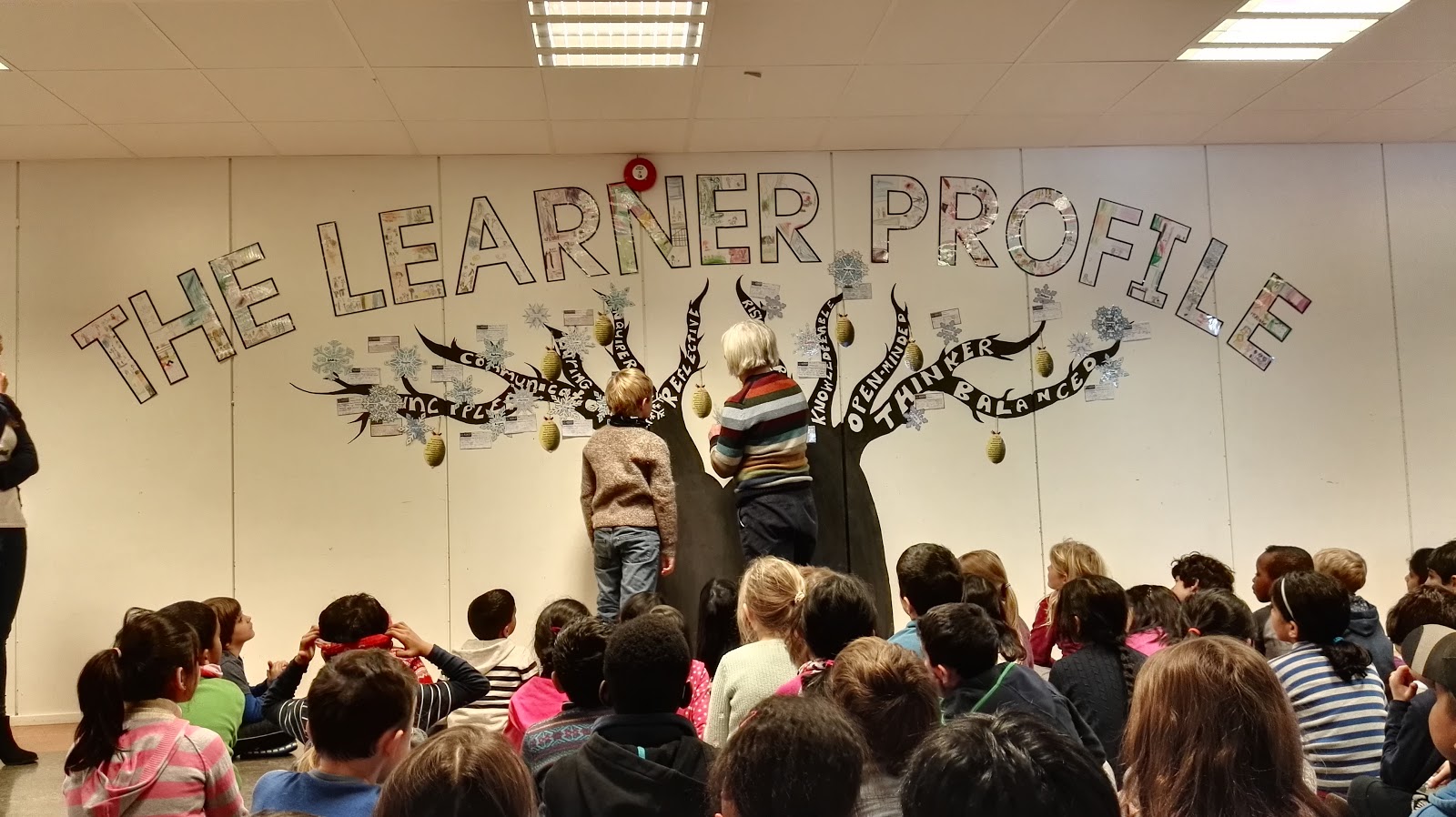
In contrast, the International Baccalaureate framework places (at all levels: PYP, MYP & DP) the child at the centre of its educational philosophy in the form of The 10 Learner Profile attributes: Balanced, Caring, Communicator, Knowledgeable, Inquirer, Open-minded, Principled, Reflective, Risk-taker, Thinker.

IB-Model.jpg

The learner profile (and its positioning at the centre of the IB framework),  means that this approach to education is a must as opposed to a should or a could.  Its position keeps our focus on attempting to develop children into successful human beings, rather than children who are successful at tests, or knowledgeable in subject content.  Consider the following extract:

Dear Teacher,
I am a survivor of a concentration camp. My eyes saw what no person should witness:
Gas chambers built by learned engineers.
Children poisoned by educated Physicians.
Infants killed by trained nurses.
Women and babies shot by high school and college graduates, so I am suspicious of education.
My request is: Help your children to become human.  Your efforts must never produce learned monsters, skilled psychopaths, educated Eichmanns.
Reading, writing and arithmetic are only important if only they serve to make our children more humane. (Ginot 1973, p24) 3

As such, the learner profile assembly (every Friday) is fast becoming my favourite school time of the week. It is a lovely reminder about the purpose of education.

learnerprofileassembly.jpg

1. http://www.thelocal.no/20131203/norway-falls-further-behind-in-maths-and-science
2. Cambridge Journal of Education, Volume 41, issue 3, 2011

3. Ginott, H. G. (1972). Teacher and Child. New York: Macmillan

Sunday, 24 January 2016

Creating a Classroom Culture for Learning: Well-being (part 2 guilt)


There will always be more to do...


/

In part 1 I argued the need for teachers to fully engage in a positive mindset towards well-being, otherwise attempts to have a positive work life balance will be futile.  Although pressures placed on teachers by school leadership, and short term knee jerk reactions by government ministers often make it difficult for teachers to have a sense of well-being.  In my opinion, the biggest barrier to achieving such a balance is ourselves.  We often refer to our employment as a vocation rather than a job.  We talk about teaching as a calling.  We surround ourselves with emotive language to remind ourselves of the importance of our profession.  Phrases such as

"We are not just teachers we are managers of the worlds greatest resource: Children!"

"Every child matters"

"No child left behind"

"What sculpture is to a block of marble, education is to the human soul"

"Education is not filling of a pail but the lightening of a fire"


are constant sources of inspiration but also place a heavy burden on our shoulders. And often this burden goes by the name of guilt.  The kind of guilt caused by thinking that you are not doing enough to help someone or some people.  Perhaps you have a student or students who is/are constantly struggling to understand a certain concept, but now you have other obligations during the weekend you must fulfil.  Or you receive an email form a parent at 9pm about how his/her daughter is frustrated and upset that she does not seem to understand the Order of Operations in Maths, yet her work shows that she has a grasp of the basics.  This is despite the fact that you have already given days and weeks of your free time considering this student when planning your lessons, but now you find you can't continue to do so.  Why? Perhaps your own children want to have you for a little while, or you life partner would like to hang out, or other students warrant your attention. Whatever the reason the guilt now starts to get to you, yet you continue to try to figure out ways to help the students despite the toll it's taking on you. Psychologists use the term 'compassion fatigue to explain this feeling of being burnout.

Remember it is your choice whether you wish to continue to make sacrifices needed to help the students, however also remember that acting out of guilt can only drain you further and make you a less effective teacher.  Your well-being is important to the long term success of your students.  If you can't maintain your health, how are you expected to control the climate in your classroom.

Sunday, 17 January 2016

Creating a Classroom Culture for Learning: Being Human Part 2


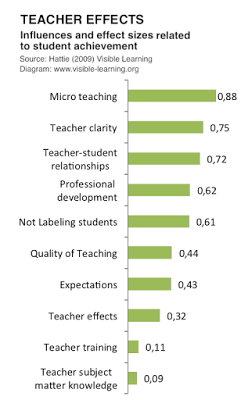
In order to build positive relationships with students I have put forward the idea that it is not enough to just know your students but that they must also know you (Being Human part 1). Whilst allowing your students to see you as something more than a teacher might make some teachers feel uncomfortable, should it help foster positive relationships, then surely this is an avenue worth pursuing.  Hattie's diagram below is a gentle reminder about the potential impact positive teacher student relationships can have on student achievement, with at least three of the factors in Hattie’s diagram related to the teacher student dynamic: teacher-student relationships; not labelling students & expectations.
An effect-size of 1.0 is typically associated with:
  • Advancing learners' achievement by one year, or improving the rate of learning by 50%
  • A two grade leap in GCSE, e.g. from a C to an A grade
  • An effect size of 1.0 is clearly enormous! (It is defined as an increase of one standard deviation)  1

With the above in mind, below are a few more strategies you may wish to consider in an effort to show the students you are human.
i) Personal Anecdotes
  1. Anecdotes show that you are human, something more than a teacher.  
  2. Anecdotes are a tool you can use successfully (sometimes) to make a point.
  3. Anecdotes help you avoid being a hypocrite. I think it is important that we model expectations.  
  4. Anecdotes allow you to model the idea of reflection.  I have rarely met a teacher who did not ascribe to the notion that schooling is about developing the whole child.  Yet whilst modelling positive behaviour, modelling expected outcomes, and modelling language are all generally accepted norms/expectations in many classrooms.  Modelling reflection (by a teacher) beyond the realm of school work is not common discourse in schools.
  5. Anecdotes sometimes enable students to be comfortable in sharing their thoughts and feelings about the themes, topics, issues covered in class.  It helps build mutual trust, and helps you create open dialogue.

Example Anecdote
During my honeymoon my wife and I climbed Half Dome in California, We set off at 5 am and made it to the top at around 2 pm, we were back down by 7.15 pm.  It is one of my most important memories from my honeymoon road trip around California. Important because I got so much wrong.  I failed to pay attention to the experience of the journey, take in the scenery, talk to fellow walkers, and enjoy the company of my life companion. Instead I was only intent on achieving my goal of getting to the summit and back down again by nightfall.  This is an anecdote I have used to remind students (and myself as a school leader) that completing work is not always about finding the right answer to a problem, it’s also about the journey taken.  For example, students are sometimes so intent on finishing a piece of extended writing quickly they forget to consider all the ingredients necessary to produce a quality piece of work (slow writing). With regards to Maths, how often do students complete maths problems without showing their working out? And how often do we witness poor teamwork by students (and adults) in the pursuit of getting work completed quickly...

However, sharing personal anecdotes does come with a health warning.  Be careful that the classroom does not become about you. This is simply a tool to ensure lessons are about them.

ii) The Playground
When on break and/or lunch duty get involved.  Talk to students about what book they are reading, or if they have watched any movies lately, or what they think of Taylor Swift’s latest song, or squeeze.  I would even suggest involving yourself in some of the playground activities such as hopscotch, skipping, basketball, football, table tennis, or even sledging/sledding:

Mr Mark Asker International School January 2015

iii) The Corridor
Smile and say 'Hi' to students on the corridor.  Remember the journey to the staffroom or the classroom is just as important as reaching your final destination.

1 http://www.teacherstoolbox.co.uk/T_effect_sizes.html

Creative Commons Licence

Friday, 1 January 2016

Creating a Classroom Culture for Learning: Well-being (Part 1)

Creating a Classroom Culture for Learning: Put your Oxygen Mask on First.


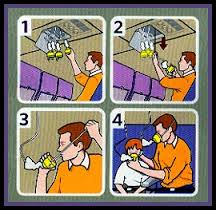
There are two reasons why airlines tell parents to put their oxygen masks on before their children when in an aeroplane. First, if you are unable to think clearly due to a drop in oxygen, you won't be able to be much help to yourself or your child. Second, if you become anxious, it will cause your child who looks to you to be calm in a crisis to become more anxious.  If you do not have children, substitute them for someone who would require your help in such a situation.


Now swap the aeroplane for your classroom; the teacher is the parent and the children are your students.  To most teachers it may seem like a contradiction to think that by looking after yourself first and foremost, you are looking after your students.  Teacher well-being is so important to ensuring that a culture of learning flourishes in the classroom.  I have mentioned previously about the importance of the teacher in controlling their own classroom climate, and the importance of teacher-student relationships.  How are these likely to be sustained if we let our own well-being deteriorate?


So I urge you to put on your own oxygen mask first when necessary. Your own well being is vital for student success. If common-sense  is not convincing enough then please consider the following:


"Researchers have long known about the infectious nature of stress. Pass-along strain runs rampant in relationships and work settings. Studies have shown that there is "crossover" stress from one spouse to the other, between coworkers, and "spill over" from the work domain to home. The stress contagion effect, as it's known, spreads anxiety like a virus. Our mirror neurons help suck us into the emotional eruptions of others."  1


The potential for your own emotional and mental state to impact on the classroom should be sufficient motivation to care for one’s well-being.  Keep the weather in your classroom fit for learning, don’t be the weather front that brings forth high winds that disrupt the learning environment.

If teachers are to be truly receptive to strategies supporting well-being, then they must embrace a well-being mindset. The first of The Five Pillars of Islam (Shahada) is the belief that there is no God but Allah, and Muhammed is his prophet (PBUH).  The other four are actions.  Actions that you would only complete should you first believe in the Shahada. One of the hardest things for a committed teacher to believe is that occasionally putting his/her own well being first is not selfish but selfless. Once you believe, then hopefully you will act accordingly, and look for opportunities to promote your own well-being.


For the benefit of your students be strong enough to take a break, put yourself first and put your oxygen mask on.

1 http://www.huffingtonpost.com/joe-robinson/dealing-with-stress_b_4097921.html

Sunday, 22 November 2015

Creating a Classroom Culture For Learning: Being Human Part 1


Explosions
Scene 1, Part 1
Mr Mark
“Be warned, there is the potential threat of ridicule, embarrassment and resentment.  But the risk might just be worth it.”  
Teacher (hesitantly)
“What  do I need to do?”
Mr Mark
“Show that you’re human”.

As a matter of interest I recently asked my new grade 7 class of 20 students to brainstorm the word teacher.  The following comments were provided: Learning; Education; Class; Homework; Bossy; Fun; Difficult; Control; Help.  Just before I was about to launch my soap box tirade that we are much more than this, one student stated Human Being.  In response to this, I asked how many other students had thought of something similar; 19 students replied in the negative.  Whilst this is clearly not a statistically representative of the world’s student population or even the school population in which I now teach, it does add weight to my theory that perhaps in order to create a culture for learning the very concept of what it means to be a teacher (in the eyes of students) needs challenging, and in order to do this we need to show we are human.
It isn't difficult to deduce from some of our experiences that students sometimes perceive us as a walking textbook, or an extension of the bricks and mortar they call a school, or even as a weapon of mass destruction.  But how many of them see us as human beings. How many of our students feel they can relate to us? Someone they can form a relationship with who they recognise is intent on helping them acquire the knowledge and skills required to have the opportunity to do want they want in life.  And as such, trust us with their future. According to Didau (2015: 344) "Trust is a better predictor of teacher success than expertise. A teacher may know their subject inside out, but if their pupils don't trust them they won't feel very motivated"  It is therefore imperative that building strong relationships with students is at the core of creating a culture for learning in the classroom.  
one-way

David Didau offers some approaches that should be the basic expectation for all teachers as part of the process for building relationships:  know their names, tell them they are your favourite class, know the data, talk to parents, mark their books.  But this advice promotes a one way relationship. You know them, but do they know you.  

I am now embarking on my fourth school experience (over 15 years) as a teacher, myTwo-way_traffic_(Israel_road_sign) second as a senior leader, and my first overseas experience in an IB school. The recommendations that I advocate promote a two way relationship with students. Recommendations I have been employing over the past four months in my new school environment.  So that maybe, just maybe, my students will trust me with their future, and see me as a human being.
i) Don't Just Attend - Take Part
ASKER INTERNATIONAL SCHOOL HALLOWEEN PARTY 2015


ASKER INTERNATIONAL SCHOOL ANTI BULLYING DANCE 2015

Teachers along back row 

Whether it is the School Disco, Halloween Party, School Prom, World Book Day, Christmas Jumper Day get involved. Don’t slink off to a corner somewhere, make an effort.  Students will appreciate that you danced rather than comment on how bad your dancing is. When you wear fancy dress for World Book Day, students will laugh (at you maybe) but this is often followed by a sincere smile and ‘I like it sir’. Be a risk-taker and let the students see you in a different context.
ii) Organise and attend residential trips
Become an overnight success that has been months or even years in the making:
  • You are the one who checks up on them in the evening.
  • You are the one who smiles and says good morning.
  • You are the one they turn to for help when attempting an activity but are scared.
  • You are the one who checks they have eaten. 
  • You are the one who they decided to talk to about things that bug them because they want their voice heard by an adult.
  • You are the one to motivate them when they are struggling on the hike.
  • You are the one they know stayed awake all night to keep them safe as they were sneaking around.
  • You are the one who took a chance and took them on their first trip outside of the city.
  • You are the one who organised their first sleep over.
  • You are the one who allowed them to see the seaside for the first time.
  • You are the one who organised their first sit down meal with friends outside of school.
  • You are the one who made a great few days happen.
Be that someone.  Show them you are human.
iii) Accept that you are sometimes wrong
Making mistakes is important in creating a culture for learning.  Remember to model this.

Part 2 coming soon...