Sometimes the simplest educational strategies are the hardest to implement. The classic example - wait time. It’s not simply a case of knowing that as teachers we should allow wait time to occur; we know that thinking does not have to be fast and it is not a prerequisite for intelligence; we know that not all students have quick processing speeds and that allowing longer processing time is an inclusive strategy; we know that our students can be shrewd, and quickly realise they can avoid thinking if they don’t put up their hands immediately; and we know as teachers it is part of our role to deal with the uncomfortable pause and the inevitable slowing down of time - yet try as we might employing wait time consistently is notoriously difficult to master.
How many of us regularly remind ourselves of the importance of waiting up to 10 seconds before asking for an answer to a question - yet despite our best intentions this strategy falls down by the wayside. Simply put - minimal wait time is a bad habit and habits are ridiculously tough to break because they usually happen without any thought, much like a reflex.
One possible solution is to employ an ‘if-then-plan’ such as the following:
After asking a question have two or three follow up statements to build the idea that hands up it not an option unless a student really does not know:
So there are only 4 students who think they have an answer hmm (tick tock)
I am therefore assuming the if you don’t have your hand up you don’t know (tick tock)
Fear of providing an incorrect answer should not stop you (tick tock)
Some practitioners avoid hands up and instead employ alternative approaches such as lollipop sticks or no hands up which come with their own benefits and pitfalls. Personally I prefer the hands up approach as it provides glimpses of additional information: Who are my slower thinkers? Who doesn’t understand? Which students don’t spend time pausing to think and leap to conclusions? Who worries about making mistakes?
Q&A is visible daily in all types of schools on the educational spectrum. Due to its frequency of use it is important that we try and get it right.
Is the death of the teacher (in Norway) inevitable?
Over the last few years I have come to the realisation that the Norwegian education system is potentially one of the last remaining bastions of safety for teachers. Its system still places teacher autonomy and professionalism at its core. In this post apocalyptic (or neoliberalism) educational world we live in, Norway’s education system is the educational equivalent of Helm’s Deep in Lord of the Rings, Zion in the Matrix, or even Narva in the year 1700 as the Swedes defended against the Russians with odds of 4-1. Many of Norway’s neighbours have fallen to the allure of neoliberalism, even Norway’s eternal ally Storbritannia has succumbed to the rise of this ideology, with its education system on its knees. The impact of such an approach to education is best summed up by Evers and Kneyber in their book Flip the System:
“It is clear that the neoliberal shift in reform has led, in a more postmodern sense, to the death of the teacher (Biesta 2013): the death of the very idea that a teacher has something to contribute, the very idea that the teacher has a meaningful voice in regard to his work, to what he wants to achieve through his work, and by which means he achieves it. Although it is a common and oft-cited belief that the quality of a system is determined by its teachers, that particular belief is of no benefit to teachers. In the neoliberal perspective, the teacher is viewed as a trained monkey, and it is simply a question finding the right stick to beat him with, or the right brand of peanuts, to make him do the desired dance in front of the audience. The teacher is no longer viewed as a professional...So clearly the old days where teachers decide on matters of curriculum, and delivery without any kind of accountability, are over. By and large, through neoliberal reform teachers’ professional identities have been monopolized in many countries by aspects of managerial professionalism.”
My worry is that in some quarters of the Norwegian education system there is an attitude of why fix it if it ain’t broken; such carelessness and complacency will ultimately lead to the downfall of a system that should be nurtured and improved. Let’s assume that the system has its flaws and requires reviewing and improving, who should be responsible for this? Again, my worry is that rather than lead this improvement, some teachers will employ a protectionism mentality underlined by an air of stubbornness: “You can’t make us!” Such a mindset will (in my opinion) only undermine the professional standing of teachers, and deepen the resolve and determination of politicians and administrators to change to a top down profession rather than a bottom up profession leading to the demise of teacher autonomy.
Having autonomy means having a responsibility to take ownership of the profession so that teachers can call it so. Teachers need to challenge the rise of government involvement and administration expertise by continuing to upskill and develop teacher expertise. This needs to be self motivated, purposeful, with a renewed mindset about what it means to be a professional. Professionals in such professions as medicine, engineering, architecture and law seek to constantly improve their knowledge, and the application of such knowledge. If teachers are not viewed in such regard by politicians, and the public, then the future is bleak. But if teachers do not hold this view of themselves then the future is inevitable; the death of the teacher.
For further information on neoliberalism and its impact on education I suggest you read Flip the System. Furthermore, a number of the contributors to the book are presenting at the researchEd Conference in Oslo on the 22nd April, further information can be found here.
"Daddy, can we go over the jumps so that you can see me jump and I can see you fall?"
The words of a six year old called Cai Fredrick on Christmas day to his father as they walked to the ski slopes. Cai's father had wanted to learn to snowboard since moving to Norway. He was desperate not to fit the stereotype that Norwegians have about people who can't ski or snowboard: Han må være engelsk eller dansk. Translated: He must be either English or Danish. Cai's father wanted to become a master of the slopes, but first he had to start at the beginning - as a novice. It had been a long time since Cai's father had been a complete novice at anything. So he began his journey as a learner. It turned out that Cai's father learnt more than just the ability to snowboard but also what it felt like to be a novice again. The constant wrestling of emotions: fear, anger, embarrassment, frustration, sadness, occasional joy, bruised pride, a deflated ego - not to mention a sore backside. All the ingredients needed to help him maintain his empathy (as a teacher) with his students in his classes. Why is such teacher empathy important to Cai's father? Because there is a strong possibility that it may help develop positive relationships with students, since students recognise that the teacher understands their struggles. It is the teacher's ability to see the school experience through the eyes of the student, which according to Kohut (2001) triggers an authentic response, leading to a positive impact on learning. Yet such an important connection may be in jeopardy from the curse of knowledge. The idea that the more expert a teacher becomes the less empathy they may be able to show towards their students.
Is it then a case of you can't have your cake and eat it? Let's hope not - teachers should strive to become experts in both subject knowledge and pedagogy, and endeavour to remain empathetic. Perhaps timely life reminders, where teachers experience the trials and tribulations of being a novice over a sustained period, might just be a suitable defence against such a curse. My suggestion, if you haven't already learnt to ski or snowboard, is to give it a go. The slopes are one humongous mixed ability classroom.
Diary of a Novice Snowboarder December 7th 2016
Dear diary, it's only two weeks away and I have been excitingly telling friends and family about how much I am looking forward to my first skiing holiday. I can't wait to feel the brisk wind sweep across my face as I weave my way down the slopes; a playground for adults. Yeeha! December 22nd 2016
Dear diary, I woke up today full of excitement. I was so confident and of course foolish when I kept asking myself how hard can it be? I looked good in all the gear and for a short time I even felt like a competent snowboarder despite my novice status. Helping the kids suit and boot took my mind of the impending playground of fun and thrills. When we walked out of the apartment I was suddenly face to face with the mountain. I have to say diary that I was momentarily giddy as I walked to its base. Adults and children were gracefully zig zagging their way down the slope. As I arrived at the T bar queue my confidence began to wane. I attempted to reassure myself by remembering my moves as a teenage skateboarder. The line was long but it was soon my turn. I was told how to grasp the T bar by the blonde Nordic attendant. I smiled and said to myself you can do it. And I did do it .............. for exactly 3 meters before I was eating Scandinavian snow. It was so embarrassing diary. The attendant even ran to my aid with a sympathetic smile, whilst the kids in the queue were rolling their eyes and whispering. The next time I managed 10 meters, after that I managed 15, and after that I only managed 3 again - what an idiot! I'm 41 for #####sake. Step forward my brother-in-law; 6ft 3in muscular frame, fair hair, chiseled face, and beard. Some say Norwegians are born with skis on their feet, in his case he snow jumped out of his mother womb on Telemark skis. What's worse diary is he is a lovely guy, everyone's best friend, with man crushes a frequent occurrence. It was baby bambi on ice next to an adult Simba in his natural habitat. I have to tell you diary - I felt pretty inadequate. So with the class pin up and jock by my side I hung onto him for my dear life as he took hold of the T bar - It was reminiscent of the scene from the original Superman movie when Superman catches Lois Lane as she falls from a helicopter.
Coming down the hill was fraught with danger as I negotiated how to stand up on a snowboard from a sitting position, and how to deal with a bruised cox bone. I only coped with a couple of hours of instruction, fear, frustration and pain before I had had enough. It was not the day I had hoped for, and not one I readily want to experience again. On the upside, my wife tells me that my 3 year old son Ketan can independently go up the T bar on skis and come down unaided. Great! December 23rd 2016
Dear diary, I was a wreck this morning. The image of people laughing at me as I attempt to snowboard was plastered across my mind. My son Cai asked me this morning at breakfast why I was grumpy. I told him my snowboard wasn't working properly. What a pathetic excuse. I did manage to take the T bar unaided to the top once. It must have been luck as I failed to replicate this success for the rest of the day. Luckily the God of Thunder (Thor), my Brother-in-Law, was on hand to help. Diary I feel like giving up.
Christmas Eve
Dear diary, I am still trying to come to terms with the Norwegian tradition of giving presents on Christmas Eve but Father Christmas was good to me. I mastered the T bar today and came down the mountain a few times without falling over. Tomorrow I will accomplish mastery of the baby slope.
Kohut, H. (2001). On empathy. The search for the self, selected writings of Heinz Kohut 1978-1981. New York: International Universities Press.
Grit has been lauded as the potential holy grail for academic success. If you have grit it is argued you a more than likely to be successfully academically and professionally.
Such ideas send Senior Leadership Teams into overdrive in an attempt to give their students additionally weaponry to succeed academically; the term Grit suddenly appears on curriculum models. SLT brainstorming sessions occur to identify what is already in place to develop grit and what else could be done. The school vision for the year adopts a grit theme to take its pride and place next to previous award winners: Accelerated Learning, No Child Left Behind, Moral Purpose. Headteachers have a new catch phrase to give backbone to support the classic statement ‘rapid and sustained improvement will be achieved by…..’ And governors can sleep at night knowing their General has a plan. All this despite no clear evidence to date that grit can be taught, learnt or developed. And of course such leaps in faith send panic through the teaching ranks at the thought of another ‘great idea’ to be implemented with a potentially short life span until the next great education eureka moment.
Whether Grit can be taught, learnt or developed, the International Baccalaureate’s curriculum model appears to be in an advantageous position due to its focus on promoting a change agent mindset in young people as opposed to grit mindset. The IB’s focus on Action as a compulsory element of the IB curriculum endeavours to help foster such a mindset. According to Asker International School:
“Action is a part of who we are. If we want to change the world we need to start with changing ourselves. If we want children to make a difference in the world we need to help them personalise the action they take, and understand that it is not just a mandate from their teachers and parents, but a life long mindset they develop. Taking action can happen at any age and may be inspired by a learning experience in the curriculum; from a homeroom project; from a student’s own initiative or from someone/an organisation outside of AIS. It’s all about how we as parents, educators, and the community, support children and youth as they begin the learning journey towards becoming adults that are change agents!”
It is this type of mindset that has been linked to students who display Grit:
“Consistently high level of impact, with pupils making an average of eight months additional progress” Education Endowment Foundation
Meta-cognition and self regulation known in the IB as Approaches to Learning can make a significant impact on students learning according to evidence provided by theEducation Endowment Foundation. Such approaches are: “usually more effective when taught in collaborative groups so learners can support each other and make their thinking explicit through discussion. The potential impact of these approaches is very high, but can be difficult to achieve as they require pupils to take greater responsibility for their learning and develop their understanding of what is required to succeed.”
Before all you progressive education supporters scream “hooray, Yes, I knew it!” I suggest that we throw caution to the wind. I gleamed two messages from the summary of the research. Firstly, successfully engaging students in approaches to learning strategies leads to significant progress. And secondly, that to deploy such strategies effectively is difficult to achieve. It is this second message that any teacher engaged in developing these strategies in their classroom should pay attention to. If the research suggests such strategies are difficult to achieve then one might infer that these strategies can occasionally, or sometimes, or even often be attempted unsuccessfully. If so, what are the consequences of such unsuccessful practice? Is it a case of no harm in trying, and students continue on some form of progressive learning trajectory just not as steep? Or do they stall or even regress? This research indicates that using such strategies are no precursor to significant progress. It is rarely the what but the how, and as practitioners we need to be diligent and disciplined in how we develop our craft. My blog onMarginal Gains and the Plateau Effect should hopefully give some indication as to the thought that goes into delivering just one small component of the Approaches to Learning framework (self and peer assessment) as prescribed by the IB.
Idealism needs to be balanced with rationalism. Our primary role is to master our craft so that we can deploy the right approaches at the right time to help children learn. But this mastery should not be at the expense of students learning. We should be strategic in our own learning curve, and practise what we preach. Using the IB's 5 ATLs: Communication; Social; Self Management; Research; and Thinking as a framework for our own practice, appears a good place to start.
The Norwegians have a saying 'ikke dårlig vær, bare dårlig klær' which translates to 'there is no such thing as bad weather only bad clothing'. The phrase is often used to put across the argument that bad weather is never an excuse not to do something. A phrase I would turn my nose up to whenever the Viking Queen (Norwegian mother-in-law) would recite this saying to me. Of course, her declaration was often in response to her witnessing my procrastination around the house when she thought I should be on a day trip with my children. My lame excuse: it’s too cold! After all, five degrees (in London) is cold, or so I thought. However, my initiation into winter football training in Norway helped me recognise that this Norwegian phrase is (almost) fact. -17 degrees, 9pm in the evening, and twenty over 40 year old men playing football.
So not only was the fierce Viking Queen, who would come and plunder my home, right, but I have come to realise that her comment is part of a collective national voice. It is this shared mindset that helps Norwegians maintain a strong bond with their local environment, and the weather. Norwegians appear to get the best out of the four seasons, with a focus on the benefits of each season as opposed to the drawbacks. Summer is for utilising the fjords by daily/weekly dips, canoeing, boat trips and daily BBQs. Autumn and Spring are about weekend walks and the opportunity to appreciate the stunning countryside, like a scene from a Jane Austen novel. Winter is snow fun time – skiing, snowboarding, sledding, igloo building, and supporting Norway's No 1 sport the biathlon.
Many Norwegians have a summer, and a winter cabin that they frequently visit, sometimes every weekend, located and built to provide a respite from the trappings of technology, and urban life. Norwegians use their natural environment to optimum effect which helps to ensure a legacy; that generation after generation will have a natural affinity to nature, and the benefits it brings. The Norwegian term for such an outdoor dynamic with nature is Friluftsliv. The term is used to describe a way of life that is often spent exploring and appreciating nature, and takes centre stage in almost all of Norway's barnehage (pre – school). Here children are taught to manage the risks of outdoor life rather than ignore it. This focus on friluftsliv is promoted to some extent throughout a child’s education in Norway, but it would appear that such thinking is perhaps a Scandinavian thing:
“Human contact with nature is decreasing in some parts of the world. For example, Tapsell et al. (2001) demonstrated that children’s access to natural environments in the United Kingdom has declined dramatically over the past few decades and that a range of physical and social factors were accelerating this withdrawal from natural environments. Kellert (2002, p.143) notes that major shifts in family traditions, recreational activity, social support networks, and community relations have eroded many children’s traditional opportunities for contact with nature."
Why should this be a worry to educators? If you believe that schools exist to simply help students pass exams then it isn't. But if you believe that schools should support children towards becoming adults that are change agents then it is. I suspect that it is mightily difficult to expect young people to truly care about mother nature, if they view it as something separate from their existence. Hence, as teachers (if possible) we should look for opportunities to use the local environment to support our lessons, especially when our earth requires more than ever for people to be sympathetic to her plight. Of course, just like my Sunday afternoon excuses, as teachers we have some plausible excuses that help us remain within the confines of the classroom. The bureaucratic process of arranging a walk to the park, forest or lake may appear more hassle than it's worth. So instead we may turn to technology to further help us justify the ignoring of a fantastic and important resource. Youtube and google cardboard (VR) are able to bring a visual experience to children's eyes that was not possible during my school days. But this technology should be a solution for potentially unrealistic ventures: the amazon rainforest, the coral reef, the solar system, not a substitute for the natural environment that is often on our doorstep.
Does friluftsliv make a difference to mother nature?
Consider the following information: Norway has the highest growth rate for electric cars in the world. With 1 in every 100 cars an electric car. Norway's entire electricity output is powered completely by hydro electricity. Norway is the 15th biggest producer of oil in the world. How many of the other oil rich nations have a similar collective mindset?
Does friluftsliv make a difference to learning?
If my emotive stance so far hasn't convinced you to look for every opportunity to take you classroom outside then perhaps the notion that providing variability in the learning environment can enhance learning:
If you’re after sustained improvement then you want to introduce as much variability into your teaching as possible: change rooms, change seating, change displays, remove the comforting and familiar background to lessons; mix up topics. These desirable topics will slow down performance but will lead to increased long term retention and transfer of knowledge between contexts.”(Didau 2015: 127)
Short story starters
As a hook
Scenario - Journalism
Poetry - The Road Not Taken: “Two roads diverged in a yellow wood.”
Transcript - Senior Team: Curriculum Model Discussion
Headteacher: “Thoughts?”
Mr Grape: “If we get rid of Learning to Learn we will have an extra period for Maths.”
Miss Plum: “Keep it as it is but make sure English exam classes are timetabled in the morning.”
Mr Apple: “Extend the school day.”
Mr Orange: “ZzzzZzzzz”
Mrs Pineapple: “Create a carousel to include Technology, Drama and Music.”
Mr Mark: “How about we design our curriculum model that works on the premise that students should have a break every hour for approximately 20 minutes.”
Headteacher: “Seriously Mark - this is no time for joking. Does anyone have anything else to add that is based on rational thinking?”
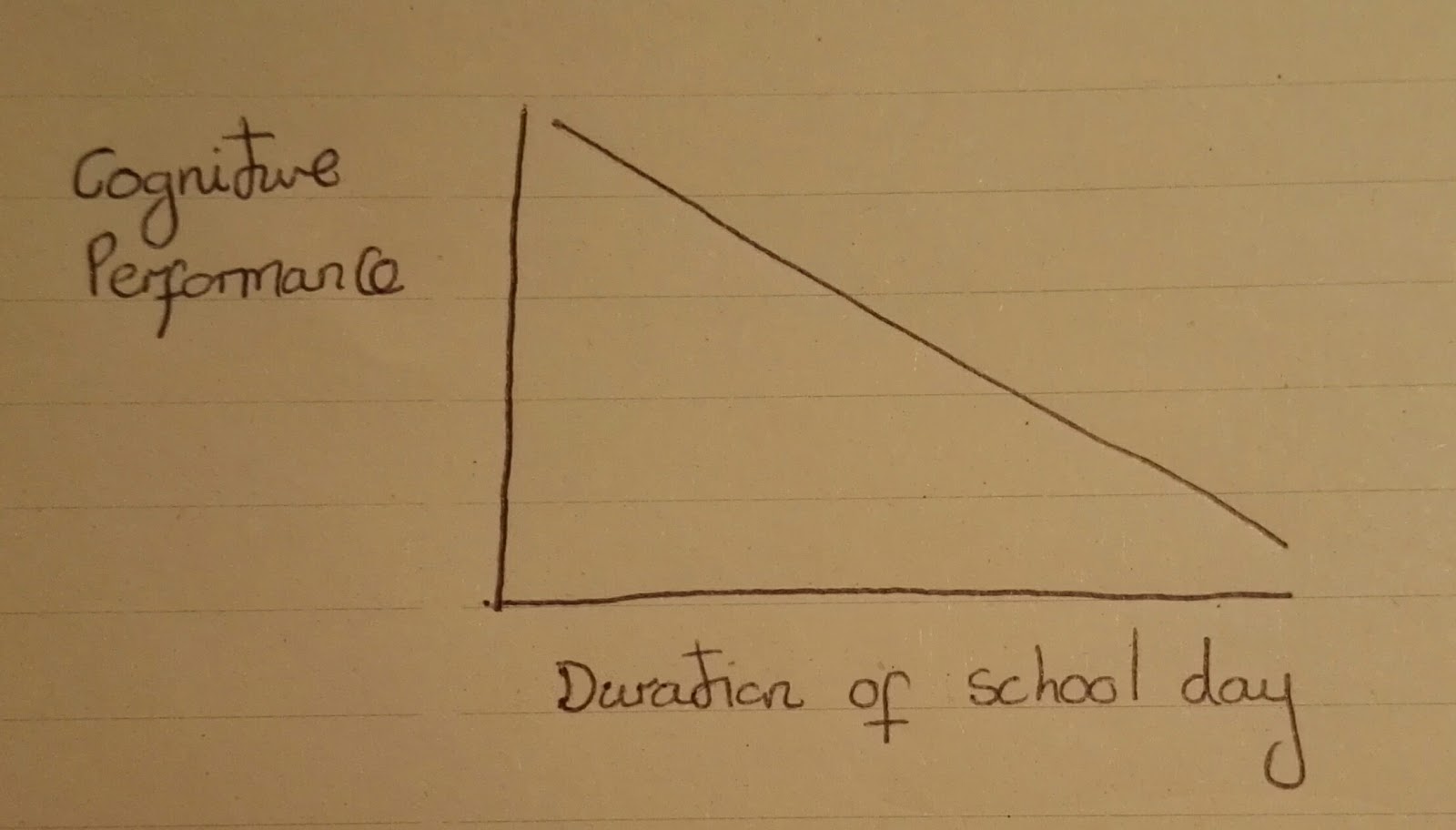
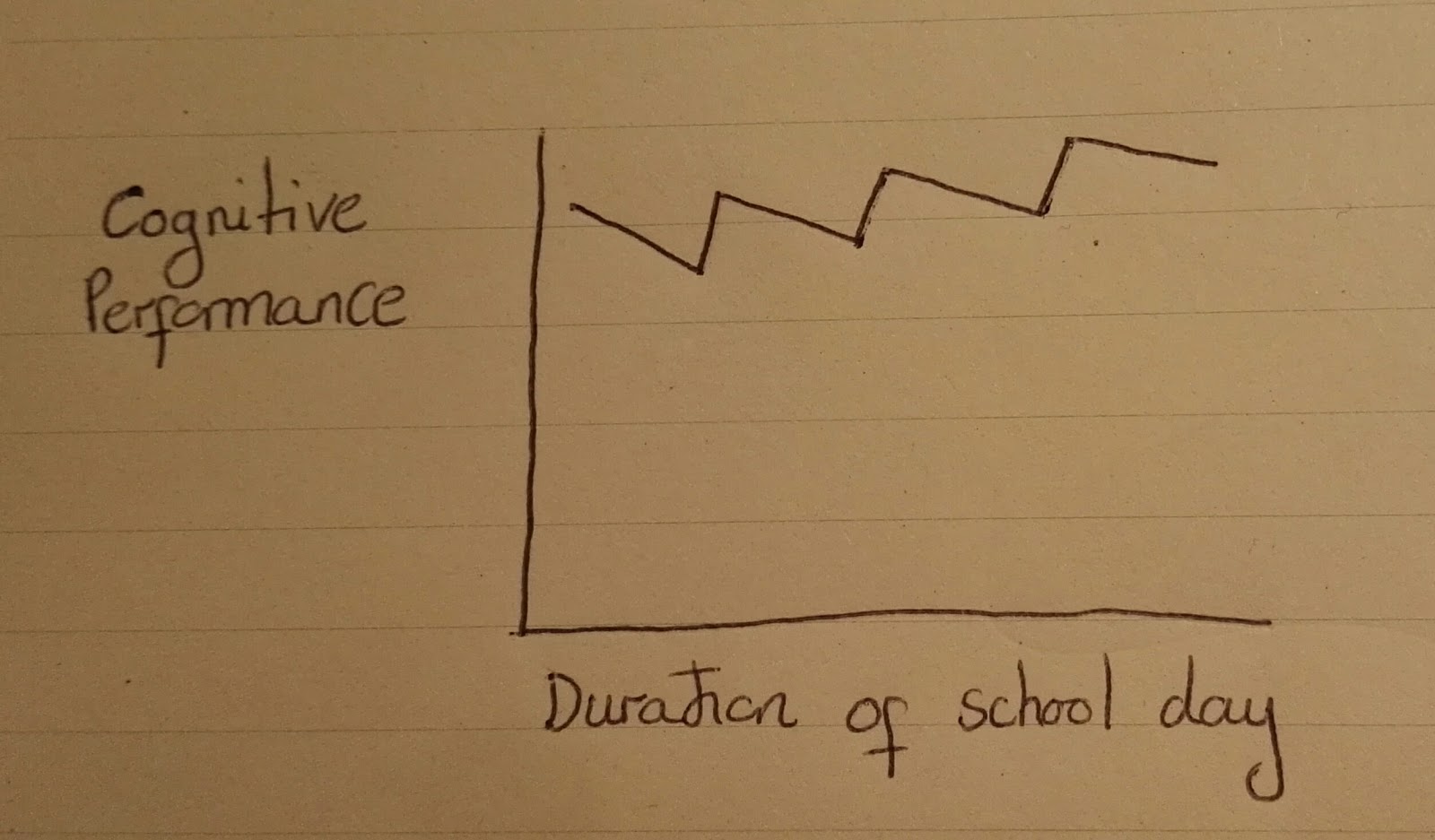
What if Mr Mark’s comments are not a joke? What if, as school leaders, we continue to create curriculum models that focus on the wrong MORE. Rather than MORE maths, English, science, norsk, Ebacc (UK) allocated time, perhaps we should focus on adding MORE break-times (recess) in an attempt to improve student performance. What a ludicrous idea, right? Wrong! According to a study conducted in Denmark, cognitive fatigue in students has an impact on tests scores, with student performance deteriorating every hour of a school day. Unfortunately, such deterioration is inevitable based on the design of a school timetable rather than as a result of some biological design flaw. If students receive a 20-30 minute break after every two hours of study, then cognitive decline is inevitable. However, if students receive a 20 - 30 minute break after every hour of study, then not only is the deterioration halted, but test performance actually improves over the school day.
Based on the above study which model should schools look to emulate?
A truthiness model showing student performance over a school day:
A reality model (based on many schools curriculum model/school day) showing student performance over a school day:
A possible model (based on a school day with a break for 20 min after every hour of study) showing student performance over a school day:
Recently I became the incarnation of Harvey Dent, determining the rewards for students by the simple toss of a coin. Despite Two Face’s actions (in response to gambling people's lives or situations on the toss of a coin) often leading to disaster and destruction. I, on the other hand, enjoyed the opposite impact; students became more eager than ever to answer questions or offer their opinion in class. All it took was a slight tweak in how I applied the school reward system: if I thought a student warranted a house point he/she was offered the house point but with the opportunity to gamble. This strategy had three areas of unpredictability:
How the House Points were awarded - I awarded a point based on student performance against the IB learner profile traits when I deemed fit
The opportunity to gamble - toss of a coin
The gamble randomly alternated between double or nothing, triple or nothing, and quadruple or nothing
I employed this strategy in the penultimate and final weeks (weeks 6 and 7) before the winter break. Whilst I would usually expect a slight decrease in student motivation during these weeks, the opposite became apparent. Student motivation appeared to increase. When I asked the class questions, I was often faced with over eagerness shouts of “me, me me Mr Mark me!”. And when offering one student the opportunity to gamble, she responded with: “This is why I love English”. Furthermore, a small group of boys who have only been learning English for 18 months threw off the shackles of worrying about making mistakes and became proactive in discussions, group work, and question and answer sessions because they hoped they would have the opportunity to gamble a house point should they be awarded one.
I think it is worth pointing out that our reward system is based on a collective approach. There is no individual gain from being awarded a house point. All students are assigned to one of four houses. And, in an effort to reinforce our host culture – our house system is named after four of the Norse Gods: Tyr, Heimdall, Buri & Skadi. House points are distributed each week by teachers if they perceive students to be demonstrating any of the IB learner Profile traits: risk-taker; caring; communicator; knowledgeable; principled; balanced; inquirer; open-minded; reflective; thinker. These points are collated each week and posted on the house competition noticeboard. As there is no personal gain from gambling a house point, it would appear that student motivation increased due to the hope of having an opportunity to gamble.
I also think it is worth pointing out that this approach is an attempt at evidence-informed practice, based on neuroscientific research conducted by Dr Paul Howard Jones. His research looks at the amount of dopamine generated in a part of the brain called the nucleus accumbens. His research suggests that the dopamine response in this part of the brain orientates our attention, and creates synaptic plasticity which is an indicator that learning has occurred. The more the nucleus accumbens (in response to dopamine) is activated, the more you are likely to remember. The nucleus accumbens is activated when the possibility of a reward is uncertain, rather than when there is consistency and predictability in the reward process. Therefore, rewards do not predict learning, whereas the brain's response to rewards does. And the brain responds to those rewards that are unpredictable; when there is a chance of no reward.
The Final Word: Two sides of the same coin
Whilst it helps that being a 'risk- taker' is one of the ten IB learner profile traits when implementing this strategy, I am conscious that during the two week implementation process not one student commented on the need to be 'principled', another of the IB learner profile traits. The idea of using the concept of gambling as a way to stimulate learning sits a little uneasy with this teacher. You see, just like Two Face or a coin, this strategy has two sides.
The Students’ Final Word:
When I offered a student the chance to gamble by the toss of a coin I stated the following:
“You have a 50/50 chance of winning!”
In response to this comment a host of hands shot up. One student then advised me that I had made an incorrect statement - That it is in fact 51/49 in favour of the side facing up when the coin is tossed:
"Not everything that counts can be counted and not everything that can be counted counts." William Bruce Cameron
The Benefit of Serving Two Masters
Within many nations, there appears to be growing uncertainty about what education should mean, each one looking over their shoulder at other neighbours, wondering how they can improve their system and gain better and better results. A country’s place in the Pisa standings appears to be quickly becoming the holy grail for politicians looking to further their own, and their parties cause. Is Norway any different?
In 2013, in response to the release of the Pisa results, Norwegian education minister Torbjørn Røe Isaksen said: "The new PISA survey shows that we have a science problem in Norway. It worries me greatly. The results are simply not good enough." The article published in the online newspaper The Local also stated: "‘It surprises me that the results are so bad,’ said Norwegian Prime Minister Erna Solberg, before heaping the blame on the previous Labour-led government.” 1
Alongside the Pisa tests, Norwegian children must also contend with National Tests. The tests, which in their current form were introduced in 2007, are to be used to inform education policy and allocate resources.However, it is widely accepted that the greater the value placed on these tests by politicians, the media, and parents, the greater likelihood there will be of a narrowing of the curriculum.
“Curriculum narrowing, however, reduces many students’ chances of being thought talented in school and results in a restriction in the creative and enjoyable activities engaged in by teachers and students. The tests commonly used with narrower curricula also appear to restrict thinking skills. In addition, responses to high stakes environments can easily retard the development of achievement in later grades as a function of the restrictions on learning in earlier grades.” 2
The narrowing of the curriculum is not just about prioritising those subjects that are tested over those that are not, it also often entails ignoring the holistic development of children. Of course, most education systems worldwide advocate a holistic approach to education. However, if discrete disciplines such as English, Maths, Science or Norwegian are placed at the centre of an educational framework then this sends a clear message to schools about what is important, especially when such high priority is placed on tests by the media and politicians. Unfortunately, I have witnessed first-hand how such a system of education leads to many teachers to de-prioritise, or even ignore many other essential purposes of education. With such testing taking centre stage, it is important to have a model of education that at its core advocates achieving academic excellence by educating our children. This is much more than just teaching subject knowledge, or worse still, teaching to the test.
In contrast, the International Baccalaureate framework places (at all levels: PYP, MYP & DP) the child at the centre of its educational philosophy in the form of The 10 Learner Profile attributes: Balanced, Caring, Communicator, Knowledgeable, Inquirer, Open-minded, Principled, Reflective, Risk-taker, Thinker.
The learner profile (and its positioning at the centre of the IB framework), means that this approach to education is a must as opposed to a should or a could. Its position keeps our focus on attempting to develop children into successful human beings, rather than children who are successful at tests, or knowledgeable in subject content. Consider the following extract:
Dear Teacher,
I am a survivor of a concentration camp. My eyes saw what no person should witness:
Gas chambers built by learned engineers.
Children poisoned by educated Physicians.
Infants killed by trained nurses.
Women and babies shot by high school and college graduates, so I am suspicious of education.
My request is: Help your children to become human. Your efforts must never produce learned monsters, skilled psychopaths, educated Eichmanns.
Reading, writing and arithmetic are only important if only they serve to make our children more humane. (Ginot 1973, p24) 3
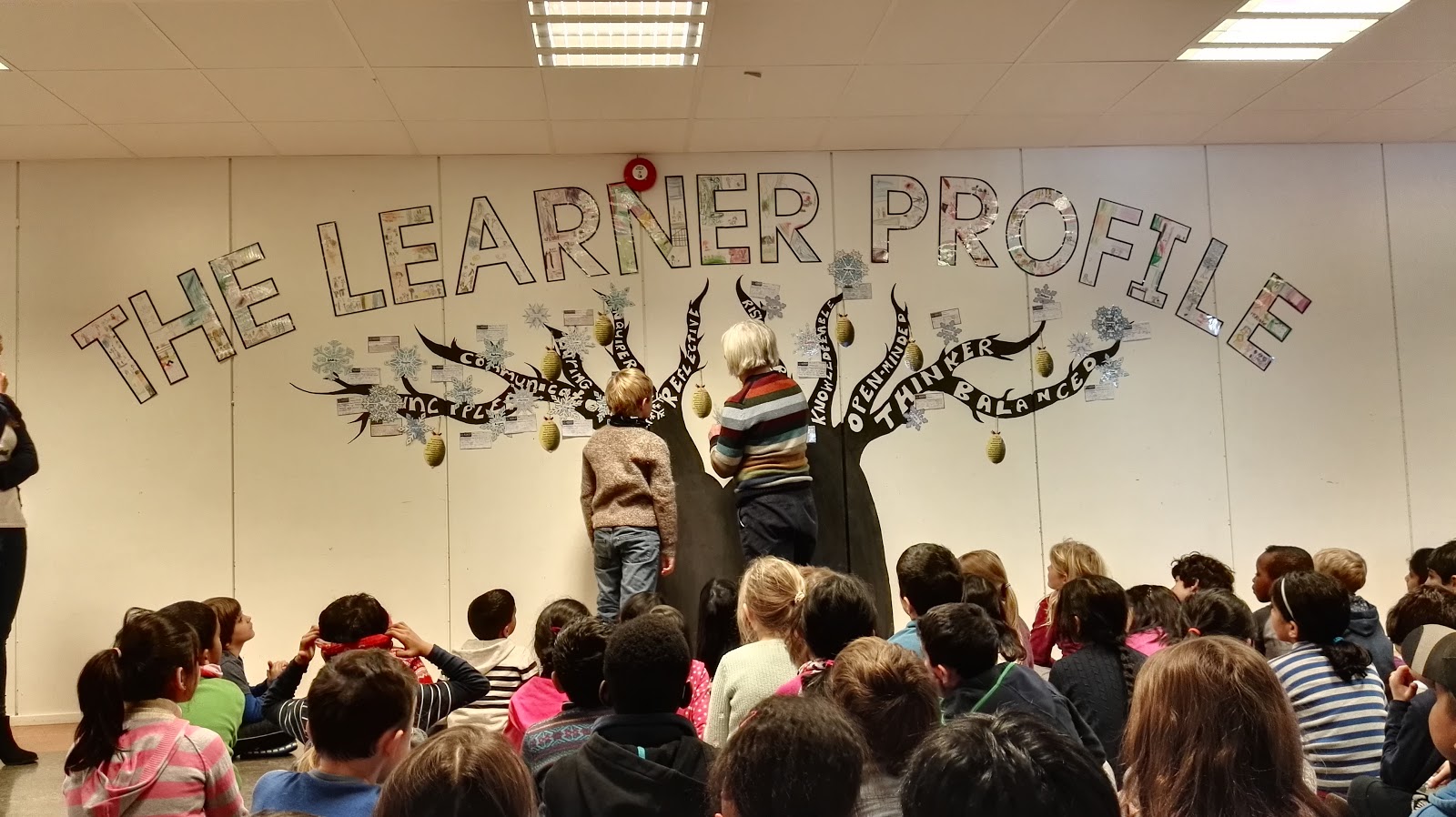
As such, the learner profile assembly (every Friday) is fast becoming my favourite school time of the week. It is a lovely reminder about the purpose of education.